

News Archives » Homepage News
Fr. Séamus Finn, OMI, Speaks at Georgetown University — Berkley Center October 23rd, 2017
Fr. Séamus Finn, in his role as ICCR Board Chair, recently spoke on Faith, Money, and Promoting Inclusive Development at Georgetown University’s Berkley Center for Religion, Peace, and World Affairs. Joining him on the panel was Dr. Jo-Marie Griesgraber of New Rules for Global Finance, based in Washington, DC.
The Interfaith Center on Corporate Responsibility (ICCR) has a long history of leading and challenging notions of ethics and accountability in the financial system through robust engagement with private institutions and corporations. Founded with the mission of building a more just and sustainable world by integrating social values into corporate and investor actions, the ICCR is often faced with navigating complex and controversial issues, ranging from banking, to mining, to labor practices.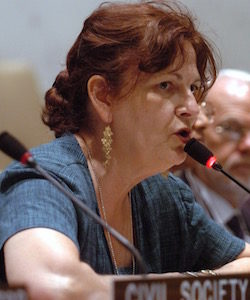
At this event, Fr. Séamus and Dr. Griesgraber explored the current challenges of inclusive and economically sustainable global development within a fragile and constrained ecosystem. They discussed how people of faith are contributing to these debates—both through the alignment of their investments with principles of their faith and by using their voice for advocacy in the public square. Dr. Griesgraber presented on the role of governments and global financial institutions and Fr. Seamus covered the role of the private sector.
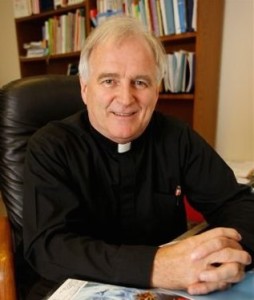 Fr. Séamus Finn, OMI is also Chief of Faith Consistent Investment for the Missionary Oblates of Mary Immaculate’s OIP Investment Trust. OIP manages the long term financial assets of the Oblate Congregation and serves over 200 Roman Catholic related entities.
The Berkley Center for Religion, Peace, and World Affairs at Georgetown University is dedicated to the interdisciplinary study of religion, ethics, and public life. Through research, teaching, and service, the center explores global challenges of democracy and human rights; economic and social development; international diplomacy; and interreligious understanding. Two premises guide the center’s work: that a deep examination of faith and values is critical to address these challenges, and that the open engagement of religious and cultural traditions with one another can promote peace. The Center was created in 2006.

October is Respect Life Month October 17th, 2017
October is Respect Life Month and is a time for us to renew our commitment to protecting those most vulnerable in our midst. There are many ways we can get involved in our parishes, and our own prayer lives.
Education
In a recent statement, Cardinal Timothy Dolan, President of the USCCB Committee on Pro-Life activities, reaffirmed the Church’s commitment to protecting human life at all stages. You can read Cardinal Dolan’s entire statement here.
The US Conference of Catholic Bishops has prepared a number of excellent resources to share with members of our parish communities. Many of these are available to print for free.
Advocacy
The Missionary Oblates JPIC continues to advocate for passage of the Conscience Protection Act of 2017. Join us in urging your rep resentatives to pass this important piece of legislation.
Prayer
Above all, let us remember to pray for an end to abortion, euthanasia, the death penalty, war, and all violations of human life.
“Only with prayer – prayer that storms the heavens for justice and mercy, prayer that cleanses our hearts and souls – will the culture of death that surrounds us today be replaced with a culture of life.”
-Pastoral Plan for Pro-Life Activities, U.S. Catholic Bishops
Mission Sunday 2017 – Catholic Diocese of Livingstone, Zambia October 16th, 2017
Mission Sunday is October 22, 2017. Organized by Propagation of the Faith, Catholics worldwide celebrate and reflect on their baptismal call of the gift of faith and re-commit to the Church’s missionary activity through prayer and generosity in support of various young mission dioceses around the world.
Bishop Valentine Kalumba, OMI, was consecrated Bishop for the Catholic Diocese of
Livingstone, Zambia in September 2016. As part of the celebration to mark Mission Sunday 2017, Bishop Valentine Kalumba, OMI, shares about challenges, growing pastoral needs and opportunities for mission work in the diocese.
The Cry of the Earth is the Cry of the Poor October 6th, 2017
By Fr. Louis Studer, OMI

Fr. Louis Studer, OMI, U.S.Provincial
The Justice, Peace and Integrity of Creation (JPIC) offices of Lacombe Oblate Province, Canada, the JPIC Office of U.S. Province, and St. Paul’s Oblates’ University sponsored a symposium at St. Paul’s in Ottawa, Canada, on August 30th, 2017, on the theme, “the Cry of the Earth is the Cry of the Poor.”
The Symposium’s goal was to heighten awareness of the interconnectedness between care for the earth and concern for all of life, especially the poor in our midst. Chief planners for the day were Br. Len Rego, OMI, Director of JPIC – OMI Lacombe Canada and Fr. Antonio Ponce, OMI, Director of JPIC – USA. Over 50 Oblates, Oblate Associates, professors, students, interested parties from both Canada and the U.S. attended the one day event. Another 80 folks followed the proceedings on-line.
Mme. Chantal Beauvais, Rector of St. Paul’s Oblate University, welcomed everyone and her brief introduction to the day included the plea for schools, especially colleges and universities to be places where theory, speculation, analysis must happen in discovering ways to care for the earth and the poor but practical applications of these theories must follow as well. Involvement cannot be only textbook analysis but must include praxis at the university level.
Fr. Gilberto Pinon, Oblate missionary in Bolivia, joined the conference by Skype. He challenged each Oblate community of the congregation to discover who the poor are in our midst and then use some practical steps in accompanying them. Oblates must give witness to an Oblate spirituality and theology of mission. That will form the basis, be the underpinning, for our care for the earth, for one another. Watch a video of Fr. Gilberto’s presentation.
Fr. Seamus Finn, OMI, Consultant to JPIC and Advisor for Corporate Faith Based Investing, outlined the Biblical tradition of who is identified as the poor and spoke about who are the “new poor” in our world. He reminded us of some more recent strategies and plans in helping the poor: “halving the number of those below the poverty line by 2020; the Paris ecology summit; new organizations founded for hel ping the poor. Watch a video of Fr. Seamus’ presentation.
Sr. Linda Gibler, O.P., Professor at Oblate School of Theology, San Antonio, summarized how the papal encyclical “Laudato Si” emphasizes the unity of all of creation. “The earth is a shared inheritance, given to all of creation, by God,” she told us. Watch a video of Sr. Linda’s presentation.
Mr. Joe Gunn, Executive Director of Citizens for Public Justice, gave some practical steps for the participants to employ in caring for the earth, caring for each other. “Laudato Si,” he said, “is not so much new news as it is good news. It is a new opportunity for us to renew our care for one another, for all of creation, even for ourselves.” Watch a video of Mr. Gunn’s presentation.
Fr. Ken Forster, OMI, Provincial of OMI Lacombe Canada Province and I, gave a brief summary of the main thoughts of the day and spoke about how the suggestions offered might be more fully integrated into each of our Oblate communities in the Canada – U.S. region. Watch the closing remarks by Frs. Ken Forster and Lou Studer.
The 36th Oblate General Chapter spoke often about an “intentional interculturality, i.e., the conscious, deliberate integration of those from other cultures, ethnicities, backgrounds, as fully participating members in our Oblate communities and ministries. Our mandate to Oblates and to those who share our Oblate charism, from the Chapter, is clear. Making the mandate part of our lives is the challenge now before us.
A joyful celebration of the Eucharist concluded our time together.
Fr. Seamus Finn Reports on Ethics and Sustainable Finance Event October 2nd, 2017
Originally Published on OMIUSA.ORG
By Fr. Séamus P. Finn, OMI
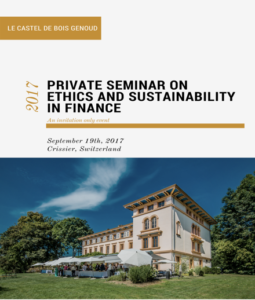
The private seminar convened on the edges of Lausanne in Switzerland in September hoped “to share innovative ideas and exchange concrete proposals on the topic of equitable and environmentally sustainable outcomes derived from the financial markets.”
The 25 participants came from academia, philanthropy, financial management and civil society to converse and consider how they might respectively bring their experiences and ideas on finances to bear on the numerous challenges that societies confront. The vision of a financial industry that would “embrace more ethical and sustainable practices” informed the mission of the organizers who wanted to use the seminar to “catalyze cooperation amongst large investors” and thereby “push concrete proposals in the financial sector.”
 Development and climate change framed the broad array of questions and challenges that were considered. The recent hurricanes, typhoons and earthquakes that have inflicted enormous suffering and damage in different parts of the world were often the point of reference for the powerful force and unpredictable path of nature’s journey. The scientific data on the contribution of human activity to dark clouds that climate change presents and the numerous efforts that have been undertaken to respond were examined and debated.
The development conversation has a much longer history and continues to be the subject of debate and evolve. While there may be some agreement about the guiding general principles and standards for measuring a meaningful and humane level of existence, there are multiple proposals about the most successful ways that these objectives can be achieved. Governments, multilateral institutions, religious and secular institutions and organizations have participated in this conversation and explored numerous avenues and vehicles to advance their projects for decades.
In the Catholic tradition, the encyclical by Pope Paul VI, “On the Development of Peoples” set a very high standard when it introduced the concept of “integral human development” into the conversation. This intervention was a clear marker, from the faith perspective, that insisted on an understanding of the human person that was much more than could be measured by the size of their bank account, the neighborhood in which they lived or their achievements in education or other pursuits. In the recent encyclical Laudato Sí, Pope Francis returns to this teaching and extends it when he speaks about “integral ecology”.
Across a stretch of nearly 50 years, major international institutions like the United Nations, the World Bank and the International Monetary Fund have participated in the conversation about “development” and “progress” alongside the numerous official, private and religiously inspired development organizations. They have been informed in this effort by the experience of numerous practitioners and the data and ideas that researchers across several disciplines have contributed.
A second set of questions that the seminar explored focused directly on the kinds of financial institutions and practices that are needed to redirect “bank lending and investment capital” to build “the livable future we want.” Recognizing that the pace of change and the size of the trillions of dollars that are needed to turn away from pathways that are destructive and into sustainable solutions, participants discussed the types of interventions that can will help mainstream capital markets and repurpose our banking system and institutions for 21stcenturies challenges.
 Improving the alignment of mission with asset management by foundations, investors and philanthropists was identified as a key driver for this kind of change. Instead of focusing only on avoiding the products and services and companies that investors and grant makers want to avoid the seminar described some of the many tools that are available and already in use to help those responsible to deploy their assets towards the kinds of future they want. They also discussed the innovative funds and research that is coming on line to facilitate the integration of sustainable development priorities into their financial planning.
The development conversation has a much longer history and continues to be the subject of debate and evolve. While there may be some agreement about the guiding general principles and standards for measuring a meaningful and humane level of existence, there are multiple proposals about the most successful ways that these objectives can be achieved. Governments, multilateral institutions, religious and secular institutions and organizations have participated in this conversation and explored numerous avenues and vehicles to advance their projects for decades.
In the Catholic tradition, the encyclical by Pope Paul VI, “On the Development of Peoples” set a very high standard when it introduced the concept of “integral human development” into the conversation. This intervention was a clear marker, from the faith perspective, that insisted on an understanding of the human person that was much more than could be measured by the size of their bank account, the neighborhood in which they lived or their achievements in education or other pursuits. In the recent encyclical Laudato Sí, Pope Francis returns to this teaching and extends it when he speaks about “integral ecology”.
Across a stretch of nearly 50 years, major international institutions like the United Nations, the World Bank and the International Monetary Fund have participated in the conversation about “development” and “progress” alongside the numerous official, private and religiously inspired development organizations. They have been informed in this effort by the experience of numerous practitioners and the data and ideas that researchers across several disciplines have contributed.
A second set of questions that the seminar explored focused directly on the kinds of financial institutions and practices that are needed to redirect “bank lending and investment capital” to build “the livable future we want.” Recognizing that the pace of change and the size of the trillions of dollars that are needed to turn away from pathways that are destructive and into sustainable solutions, participants discussed the types of interventions that can will help mainstream capital markets and repurpose our banking system and institutions for 21stcentury challenges.
Improving the alignment of mission with asset management by foundations, investors and philanthropists was identified as a key driver for this kind of change. Instead of focusing only on avoiding the products and services and companies that investors and grant makers want to avoid the seminar described some of the many tools that are available and already in use to help those responsible to deploy their assets towards the kinds of future they want. They also discussed the innovative funds and research that is coming on line to facilitate the integration of sustainable development priorities into their financial planning.
The Sustainable Development Goals: 17 Goals to Transform Our World
Finally, the seminar explored the role of businesses in supporting through a collaborative multi stakeholder process the achievement of the Sustainable Development Goals that were adopted by the UN General Assembly in 2015. Examples such as “circular economy,” “social impact bonds” and local currency projects from different regions in the world were examined and the possibility of their deployment and scalability was discussed.
Conclusion
The core issues raised by this seminar, encouraging “the financial industry to embrace more ethical and sustainable practices”, must remain a top priority in protecting the planet and building a sustainable future. The centrality of a financial system that provides equitable access to capital across all sectors of the world and respects the planet in the process is critical. Many current practices and policies have failed miserably to achieve these objectives.
This priority, by no means, ignores the numerous efforts and projects to alleviate poverty, end hunger and provide access to healthcare that are being undertaken by innumerable institutions, organizations and individuals across the world. It does however point to the necessary structural and policy reforms that must be made to the financial system and the practices of the financial industry if the scale of the challenge is to be addressed and the needed changes are to introduce reliable platforms for sustainable solutions.
