

News Archives » Resources
NOGs and Religious Groups Call for Inclusion of Human Right to Water and Sanitation in SDGs July 7th, 2014
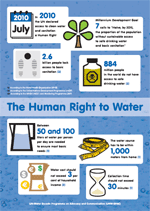 More than 300 Non-governmental Organizations (NGOs), including Missionary Oblates of Mary Immaculate, recently sent a statement to the General Assembly’s Open Working Group on Sustainable Development Goals (SDGs) to explicitly affirm its commitment to protect and promote the human right to water and sanitation within the SDG framework and implementation:
“We join the repeated and insistent calls from civil society around the world to ensure that the SDGs are explicitly aligned to the human rights framework. For the post-2015 development agenda to reach its objective of being just, people-centered, and sustainable, the goals must prioritize-for present and future generations-the human right to water for health, life, food, and culture over other demands on water resources. This is even more critical given the key role of water for achieving other sustainable development objectives such as sustainable energy and food production, gender equality, and climate change mitigation.
SDGs must be designed to catalyze increased capacity and political will for States to fulfill their legally binding obligations to respect, protect, and promote the human right to water and sanitation. Our organizations fear that the human right to water and sanitation continues to be contested within the context of a global competition for scarce water resources. We are concerned that a development agenda that is not explicitly committed to upholding this vital human right may end up undermining it.”
Click here for good resources on the UN Human Right to Water: Human right to water and sanitation | International Decade for Action ‘Water for Life’ 2005-2015
Click here for eight fast facts on the HR to Water and Sanitation (poster)
USCCB Infographic to Stop Slavery! July 2nd, 2014
Please watch this new info-graphic from the US Catholic Bishops’ Conference Anti-Trafficking Program, and take action today!
Resolution Supported by Vatican Adopted at UN HR Council June 27th, 2014
 A resolution calling for establishment of a process to look into making the UN Guiding Principles on Human Rights and Corporations enforceable was adopted yesterday by the UN Human Rights Council. Among other things, the resolution establishes “an open-ended intergovernmental working group on a legally binding instrument on transnational corporations and other business enterprises with respect to human rights, the mandate of which shall be to elaborate an international legally binding instrument to regulate, in international human rights law, the activities of transnational corporations and other business enterprises…
Fr. Seamus Finn, OMI, who represents the Oblates in dialogs with major multinational corporations said: “This resolution from the UNHRC is an important milestone in advancing the protection and promotion of human rights and provides transnational corporations with both the opportunity and the framework to participate in this essential endeavor.”
The full text of the UN Resolution is available here….
Vatican Issues Statement on the UN Guiding Principles on Business and Human Rights June 25th, 2014
 His Excellency Archbishop Silvano M. Tomasi, Permanent Observer of the Holy See to the United Nations and Other International Organizations in Geneva submitted a statement on the UN Guiding Principles at the 26th Session of the Human Rights Council on June 11th. The statement, titled “Report of the Working Group on the issue of human rights and transnational corporations and other business enterprises” is excellent, calling for the need to broaden dissemination of the principles, attain scale in implementation, build trust among stakeholders and overcome barriers to effective remedy.
The Guiding Principles on Business and Human Rights (Guiding Principles) were endorsed by the United Nations Human Rights Council on 16 June 2011. The Guiding Principles provide an authoritative global standard for addressing adverse impacts on human rights linked to business activity around the world.
The Guiding Principles set out, in three pillars, principles concerning the State duty to protect human rights, the corporate responsibility to respect human rights, and access to remedy for victims of human rights abuse.
The following gives a flavor of the statement that reflects fully the Vatican’s concern for the impact of powerful economic structures and activity on the lives of ordinary people:
“The ability of international corporations to partially escape territoriality and carve for themselves an existence “in-between” national legislation is rightly one of the concerns of the International Community. Their mobility in terms of their country of incorporation, management, production, and financial flows allows them to navigate national legislations, take advantage of regulatory arbitrage and choose the jurisdictions that may offer the best return in terms of profits. Pope Francis, in his Apostolic Exhortation “The Joy of the Gospel”, and other religious leaders in the International Community have repeatedly pointed out that profit cannot be the only rationale of business activity. Transnational corporations are part of the human family and as such their activity should abide by the standard of human rights.”
“Another point of concern to the International Community is the inherent complexity of the transnational corporations regarding their diverse operating models (modus operandi) which makes them very hard to monitor and supervise. The resulting absence of robust and timely transparency makes it very difficult to measure compliance with rules and legislations. Human rights violations all too often occur out of utter neglect toward consequences that would have been foreseeable had anyone cared to think about them. These sorts of “neglects” are not casual, but systemic.”
IMF Paper: Corporate Tax Avoidance Hurts Global Economy and Poor Countries June 25th, 2014
 The International Monetary Fund (IMF) released a staff paper noting that corporate tax avoidance negatively impacts all economies, but hurts developing countries the most. The IMF’s release comes as the G20, the Organization for Economic Cooperation and Development and United Nations bodies seek vehicles to diminish corporate tax avoidance.
“The developing world loses more in corporate tax avoidance than it receives in aid from developed countries,” stated Eric LeCompte, Executive Director of the religious anti-poverty group, Jubilee USA Network. “The paper shows that when multinational corporations shift their profits to another country to pay less taxes, we see higher levels of global inequality.”
The IMF paper is entitled “Spillovers in International Corporate Taxation.” “Spillovers” are the impact of one country’s policies on another country. By shifting profits to countries with low tax-rates (often so-called “tax havens”), corporations avoid paying their taxes in the countries where they make those profits. The paper notes that this is a particularly large problem in developing countries, which need corporate taxation to fund social services. The paper argues that “many developing countries…need to be better protected against the avoidance of tax on capital gains on natural resources.”
“These ‘spillovers’ are more like a flood,” noted LeCompte. “For every $1 poor countries are receiving in official aid, nearly $10 is leaving through corruption and tax avoidance.”
Thanks to Jubilee USA for this information.
