

News Archives » 1934 Securities & Exchange Act
Fr. Séamus Finn, OMI, Discusses Ethics in Finance with Stanford University Students November 18th, 2026
 |
 |
(Contributed by Fr. Séamus Finn, OMI)
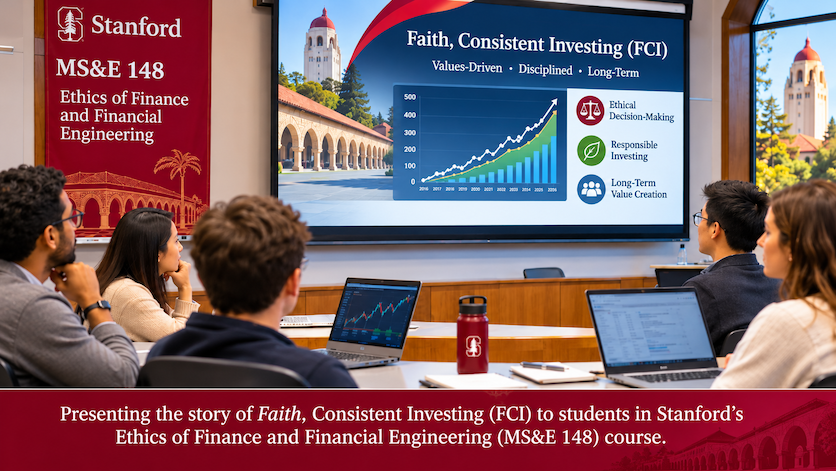
It was a great opportunity to present the story of faith and consistent investing (FCI) to the students in the Stanford University Ethics of Finance and Financial Engineering (MS&E 148) course on Monday, November 16th.
We reviewed the founding of the Interfaith Center on Corporate Responsibility (ICCR), which emerged from the commitment and advocacy of faith-based investors who were committed to ending the apartheid system in South Africa. Many of these same faith-based investors worked to pressure world governments to sanction the Government of South Africa that had sustained and were promoting this oppressive system. In the late 1960s and for over 50 years, ICC R has continued to call out and remind private companies of their responsibility to include in their company policies and practices a commitment to human rights, human dignity, and care for the environment.
The 1934 Securities & Exchange Act recognized the rights of shareholders to engage with the management of companies in which they hold shares. Shareholders generally do this by presenting resolutions for consideration at the company’s annual meeting, and they are encouraged to vote their proxies in favor of said resolutions. This has been the vehicle whereby members of ICCR have engaged corporations for well over 50 years, often joined by other investors who share these priorities.
Unfortunately, the Securities and Exchange Commission has proposed amendments to the rule that are allowed these practices. And if finally adopted after the appropriate period of public comment, this would weaken and almost eliminate the rights granted in the 1934 law.
In light of the numerous productive engagements that faith-based investors have Initiated with corporations in all sectors of the economy, the proposed changes to the rules that are contemplated are counterproductive and will deprive companies of a channel that has served as a conduit for hearing from responsible investors who are also a source of ideas that have in fact made a positive contribution to these companies.
