

News Archives » indigenous peoples
NGOs Raise Alarm About Hydroelectric Dam in Guatemala October 15th, 2014

In August of 2013, the community was attacked and two children were killed in retribution for human rights complaints filed by the community.
The Missionary Oblate JPIC Office has joined other international organizations in a letter of concern to the UN Special Rapporteur on the Rights of Indigenous Peoples about construction of the Santa Rita Hydroelectric Dam in Guatemala. The dam was registered as a project under the Clean Development Mechanism (CDM) – established under the UN’s Kyoto Protocol – in June 2014. According to the letter, “Numerous violations against the indigenous Q’eqchi´ and Poqomchí communities have been reported prior to and since project approval, most recently in violent incidents from 14 to 16 August 2014 resulting in several injuries and deaths.”
The letter notes that the Inter-American Commission on Human Rights’ Rapporteur on indigenous peoples’ rights recognized “that the current licenses for mining and hydroelectric plants were granted without the State having implemented prior, free, and informed consultation with affected indigenous communities, as it is obligated to do under international treaties signed by Guatemala”.
Forum on Indigenous Peoples in Bangladesh Highlights Outstanding Needs August 19th, 2014
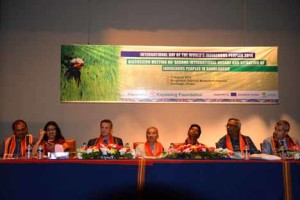 On August 11, 2014, Kapaeeng Foundation of Bangladesh held a forum on the “Second International Decade and Situation of Indigenous Peoples in Bangladesh” at the National Museum auditorium in Dhaka. The meeting was organized to celebrate International Indigenous Peoples Day 2014.
The Honorable Chairman of Chittagong Hill Tracts Regional Council and President of Bangladesh Indigenous Peoples Forum, Mr. Jyotirindra Bodhipriya Larmawas presented as the guest of honor, while Mr. Rabindranath Soren, Chaiperson of Kapaeeng Foundation presided over the program.
Speakers and special guests included Mr. R A M Obaidul Muktadir Chowdhury MP, Honorable Chairman, Parliamentary Standing Committee on Ministry of Chittagong Hill Tracts Affairs; Mr. Fazle Hossain Badsha, MP; Pir Fazlur Rahman Misbah, MP; Professor Dr. Sadeka Halim, Former Information Commissioner; Mr. Snehal V Soneji, Country Director, Oxfam; Mr. Gonzalo Serano De La Rosa, representative of the European Union; Mr. Mika Kanervavuori, representative of UN; Mr. Sanjeeb Drong, General Secretary, Bangladesh Indigenous Peoples Forum. Sanjeeb Drong is a close collaborator of the Oblates in Bangladesh.
Sanjeeb Drong said, the rights of indigenous people are human rights. If government does not fulfill the rights of indigenous peoples, we cannot say the human rights situation is developed in Bangladesh. So the government has to protect and promote the rights of IPs. He also said, “Land is the life of indigenous peoples. But day-by-day, indigenous peoples are losing their land. To protect the land of IPs, I demand to setup separate land commission for IPs.”
He also mentioned that, “We all are humans, and despite this we face discriminations and injustice.”
Read a full account of the forum here (Download PDF) or visit the website of the Kapaeeng Foundation.
Dialogue on Life and Mining from Latin America December 10th, 2013
Religious and Lay representatives from Latin America, “moved by the critical situation of our peoples vis-à-vis the extractive industry”, met in Lima in November 2013. Concerned that mining is a source of “constant and serious conflict” in many countries of Latin and Central American countries, the attendees wanted to develop a vigorous and supportive set of local and international networks to help address the destructive impacts of mining. The Missionary Oblates were represented by Fr. Gilberto Pauwels OMI from Bolivia, and Fr. Seamus Finn OMI from the United States and through their participation in VIVAT, a coalition of religious congregations with ECOSOC status at the United Nations.
There are a number of outcomes from the gathering that included reaching out to a larger number of communities affected by mining, engaging with the Pontifical Council for Justice and Peace at the Vatican and convening a broader consultation on the challenges of extractives in the second half of 2014.
Extractives, mining oil and gas exploration, play an important role across the world while also imposing great intrusion and damage in local communities and on the environment where they operate. The search for a way forward that addresses the most serious of those negative impacts has been taken up by a number of different initiatives in the academic, business, stakeholder and shareholder and NGO sectors. Hopefully gatherings like the meeting in Lima can make a constructive contribution to that process.
Read the statement: Dialogue on Life and Mining: Open letter from religious and lay stewards of the goods of creation in Latin America
United Nations Opportunities November 4th, 2013
 Through the Missionary Oblates of Mary Immaculate and the VIVAT International NGO Office, persons in our network are able to participate in major UN meetings in New York City. There is no fee to attend these sessions, but participants are responsible for their own transportation and room and board. If you are interested in attending a major UN meeting in New York in 2014, contact Daniel LeBlanc OMI as soon as possible at dlkomijpic@yahoo.com
February 11 – 21, 2014: 52nd Commission on Social Development (CSocD 52)
March 10 – 21, 2014: 58th Commission on the Status of Women (CSW 58)
May 12 – 23, 2014: 13th Permanent Forum on Indigenous Issues (UNPFII 13)

Helpful Resource: Action Through Words
Action through Words is an online study course that helps users deepen their knowledge of the history and workings of the United Nations while expanding their knowledge of the English language and communication skills. This program is designed for anyone wanting to explore the work of the UN, especially those working where access to formal language training is limited. Go to: www.unepd.info/index.html
VIVAT International Submission on Mining and HR June 3rd, 2013

Newmont Mining Protests in Peru
VIVAT International submitted an Oral Statement to the 23rd Session of the UN Human Rights Council on the issue of human rights and transnational corporations. The submission focused on concerns related to mining activities and their negative effects, particularly on indigenous peoples.
A directive signed last year by Brazil’s Solicitor-General “opens up all indigenous areas to mineral, dams, roads, military bases and other developments of ‘national interest’ without the need to consult with or address concerns of indigenous peoples”, according to an expert familiar with the directive who asked to remain anonymous. It also restricts demarcation of new indigenous territories. A similar dynamic is underway in Peru, where the government recently backslid on implementation of the Indigenous Peoples Consultation Law (Consultation Law). The landmark law, passed in 2011, requires the Peruvian government to consult indigenous peoples affected directly by development policies and projects such as oil drilling, mining, roads and forestry. Consultations must aim to achieve agreement or consent. The hope was that the law, if implemented effectively, could help reduce the number of violent conflicts that frequently emerge in the country’s oil and mining industries.
However, in early May, Peru’s Vice Minister of Culture Ivan Lanegra—responsible for overseeing implementation of Peru’s Consultation Law—resigned in protest following Executive branch declarations that highland (or campesina) communities do not qualify as indigenous peoples. At the same time, the Peruvian government announced that it will proceed with 14 mining projects located in the Peruvian highlands without prior consultation with neighboring communities.
